

The new system shifts influence upstream. Here’s how planners can help clients engage at the right time, in the right process, on the issues that matter most.
The Planning and Natural Environment Acts may have replaced the Resource Management Act on paper, but for most planners the immediate question is much simpler: What should we be telling clients today?
That was the question we put to a room full of planners last week. The discussion quickly moved beyond legislative detail and onto the practical: how planners can add value during a 3 ½ year transition period.
Our top five things planners should be doing now are set out below.
1. Don’t assume waiting is the best strategy
One of the most common questions we are receiving is whether clients should wait for the new system before progressing projects.
Our view is simple: Waiting is a strategy. It is not a default option.
For some projects, waiting may lead to simpler pathways and a more favourable planning framework. For others, waiting may simply create years of uncertainty. Clients considering whether to lodge now should be asking:
- What version of the law will apply?
- What are the benefits of delaying?
- What are the risks of delaying?
- Could the planning framework become more restrictive rather than less?
- Are there project-specific reasons to secure approvals now?
The answer is rarely a blanket “lodge” or “wait”. It is usually a project-specific risk assessment.
2. Start thinking beyond resource consents
One of the biggest shifts in the new system is that more strategic decisions will be made earlier.
The traditional approach has often been to focus attention on plan changes and resource consent processes. Under the new framework, the intention is that most of the significant decisions should occur well before individual projects ever reach the consenting stage. Under the new “funnel” system, (replacing the current “triangle” planning hierarchy), strategic direction is expected to be set nationally and then regionally, with less opportunity to revisit decisions later through individual consents.
Practical implication
If your client has long-term interests in:
- major infrastructure;
- urban growth;
- development sequencing;
- transport corridors;
- rural land use; or
- environmental limits;
then waiting until a consent application is lodged may be too late. The most important planning conversations may occur years before the first AEE is prepared.
3. Map where your client’s interests sit in the new system
Over the next 3 ½ years, planners will see the development of national policy directions, national standards, regional spatial plans, land use plans and natural environment plans. Different clients will need to engage at different stages.
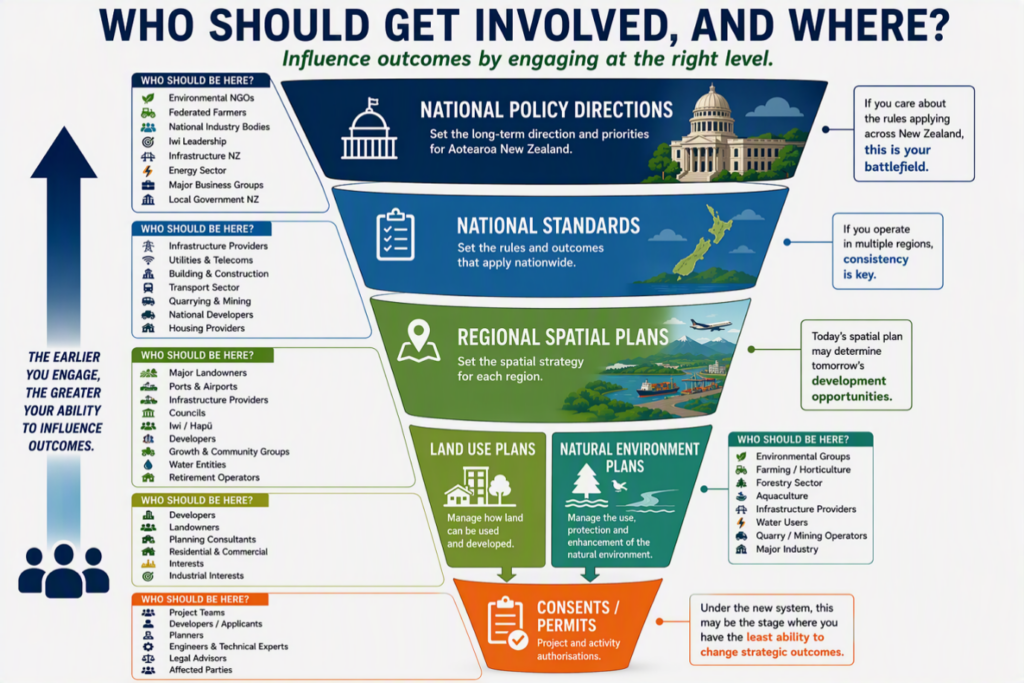
The key question is no longer: “When do submissions open?”
The better question is: “Which upcoming process will have the greatest influence on my client’s future activities?”
4. Change how transition-period applications are prepared
The transitional amendments are not just administrative tweaks. From 30 October 2026, applicants and decision-makers must operate under a modified RMA framework, including new procedural principles and a narrower scope for certain effects. One practical change we expect to see immediately is greater focus on whether information is genuinely necessary for the scale and significance of a proposal.
Planners preparing applications for lodgement after 30 October should be asking:
- What effects remain relevant?
- Which effects are now out of scope?
- Is every piece of expert evidence necessary?
- Do proposed conditions inadvertently regulate matters that are no longer relevant?
- Does the application explain why the information provided is sufficient and necessary?
In our view, the strongest transition-period applications are likely to be the simplest ones.
Less information for the sake of information.
More focus on the issues that actually matter.
5. Audit client portfolios now
Many planners are focused on future projects.
An equally important exercise is reviewing existing approvals. Existing resource consents generally continue during the transition period and various rollover provisions apply. However, the transition creates important strategic questions around timing, expiry dates, replacement consents and future investment decisions.
A useful conversation with key clients right now is: “Let’s sit down and review everything you’ve already got.” That discussion may identify opportunities or risks that are much more immediate than debating what the planning system might look like in 2030.
A Planner’s Transition Checklist
When advising clients over the next 12 months, consider:
- What is the intended lodgement date?
- Does it matter if the application is lodged before or after 30 October 2026?
- Which upcoming planning processes could affect the project?
- Are there opportunities to influence outcomes upstream?
- Which effects remain relevant?
- Which effects are now out of scope?
- Are there alternative pathways available?
- Have existing consents and expiry dates been reviewed?
The Bottom Line
The RMA may be on the way out, but planning has not become any less important. If anything, planners have an even greater opportunity to add value by helping clients navigate uncertainty, identify the decisions that matter most, and engage before those decisions become difficult to change.
The winners under the new system will not necessarily be those with the best resource consent applications. They are likely to be the clients who engage early and help shape the framework those applications sit within.