
While much of the reform discussion has focused on the new planning framework and transitional provisions, hidden away in Schedule 10 of the Planning Act is a new dispute-resolution body: the Planning Tribunal.
For years, relatively minor procedural disputes have travelled through the same pathways as major planning appeals. The Planning Tribunal is intended to create a separate lane for those disputes, reduce congestion and allow the Environment Court to focus on substantive planning issues.
For planners, applicants, submitters and councils, understanding where disputes will end up will be critical.
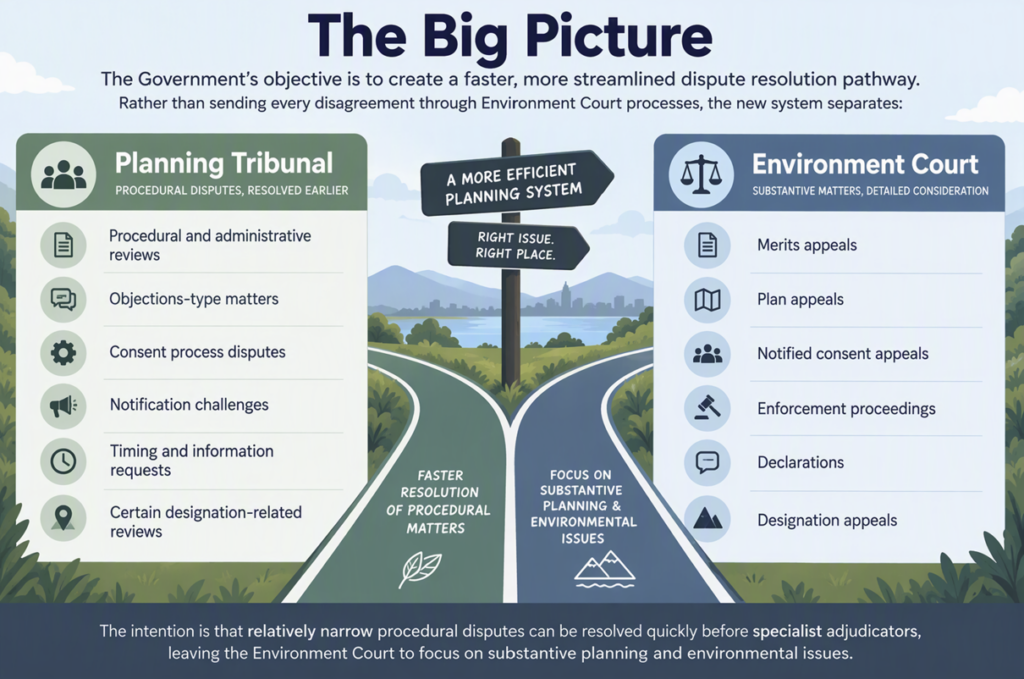
Broadly, the reforms draw a clearer distinction between disputes about process and disputes about planning merits. A range of specified procedural and administrative disputes will sit with the Tribunal, while substantive appeals and enforcement proceedings will generally remain with the Environment Court. The boundary is not absolute, however, and some matters may involve alternative or overlapping pathways.
What is the Planning Tribunal?
The Planning Tribunal will operate as a specialist decision-making body established under Schedule 10 of the Planning Act. Although it will be a division of the Environment Court and able to draw on Environment Commissioners as adjudicators, it will have its own Principal, Deputy Principal and appointed Adjudicators. Its procedures will be governed by the Act, regulations and Tribunal rules. Registrars may also be appointed to the Tribunal.
The Tribunal has been established by the Planning Act, although the commencement of its jurisdiction and the transition of particular dispute pathways will be phased. It is expected to become operational in 2027, providing a faster and more accessible forum for specified procedural and administrative disputes.
Why was the Planning Tribunal created?
Under the RMA, procedural disputes were often dealt with through objections, judicial review proceedings or Environment Court processes, even where the underlying issue had little to do with planning merits. In particular, a person seeking to challenge a notification decision has generally had to consider judicial review in the High Court, rather than having access to an ordinary merits appeal against that decision.
The new system directs many of these issues to the Planning Tribunal rather than the Environment Court or High Court. The intention is to divert specified procedural disputes into a more proportionate specialist forum, reducing the need for parties to use conventional court processes for comparatively narrow administrative issues.
What kinds of matters will the Planning Tribunal hear?
The Tribunal’s jurisdiction is outlined in Schedule 10 of the Planning Act and differs from the Environment Court in the following ways:
Planning Tribunal
Procedural disputes, resolved earlier
Consent processing reviews
- Decisions that an application is incomplete
- Requests for further information
- Requests to commission reports
- Extensions of statutory timeframes
- Failure to comply with statutory timeframes
Notification reviews
- Notification decisions for consents, permits and designations
- Challenges generally focused on legal or procedural error rather than planning merits
Consent condition disputes
- Interpretation of consent conditions
- Applications to strike out conditions considered outside the lawful scope of the system
Existing use and administrative decisions
- Existing use certificate decisions
- Additional charges and cost recovery disputes
- Certain regulatory relief decisions
Designation reviews
- Decisions by designating authorities declining permission for works within designated areas
Environment Court
Substantive matters, detailed consideration
Plan appeals
- Appeals on proposed plans
- Appeals on plan changes
- Appeals on many planning rule issues
Consent appeals
- Appeals on notified consents
- Appeals on reviews and changes of consent conditions where submitters are involved
Designation appeals
- Appeals relating to designations and notices of requirement
Enforcement
- Enforcement orders
- Appeals on abatement notices
- Other enforcement proceedings
Declarations
- Applications seeking declarations about interpretation and legal meaning
A useful way to think about the difference is:
Did the process go wrong? Think Planning Tribunal.
Was the planning decision right on its merits? Think Environment Court.
Why should we care?
Based on the new framework created, the Planning Tribunal may well become one of the most commonly used institutions in the new planning system. As outlined above, the Tribunal will be home to more mundane administrative disputes, while the Environment Court and beyond will deal with the substantive merits of decisions. The practical result should be a clearer separation between administrative disputes (Tribunal) and planning merits disputes (Environment Court).
Some disputes that currently contribute to delay during application processing will instead have a dedicated review pathway through the Tribunal, rather than being addressed through existing objection, court or judicial review processes.
For applicants, the Tribunal may provide a faster and cheaper mechanism for challenging delays, information requests and other processing decisions.
For councils, it introduces a new layer of scrutiny over administrative decision-making.
For practitioners, it creates an entirely new forum with its own procedures, powers and strategic considerations.
When will the Tribunal matter?
The Tribunal’s practical role will emerge in stages. While some provisions relating to jurisdiction during the RMA transition depend on commencement by Order in Council, it is likely the Tribunal will have a key role to play during the transition.
Strategic implications
The Tribunal is not simply a mini Environment Court. Its paper-based starting point, limited appeal rights and potential to order costs will place greater weight on the administrative record created before proceedings begin. Applicants will need to respond carefully to information requests, identify disputed statutory timeframes early and preserve the material supporting any procedural challenge. Councils, in turn, will need clear reasons and a defensible record for reviewable processing and notification decisions.
Forum selection will also matter. Some disputes may sit within alternative or overlapping pathways, and the Tribunal may transfer proceedings. Before filing, parties should identify the precise decision being challenged, the available statutory route, the remedy sought and any effect the proceeding may have on the underlying consent or designation process.
Five features practitioners should know
1. Flexible powers
The Tribunal can confirm, modify or overturn decisions, remit matters back to the decision-maker, formalise party agreements, stay consents and set revised statutory timeframes. The Tribunal can also transfer proceedings to the Environment or other Courts.
2. A paper-based starting point
Hearings are not the default. Most matters are expected to be determined on the papers unless the Tribunal considers that a hearing or rehearing is required on the basis of complexity or fairness. If a hearing is held, legal representation is permitted.
3. Strong investigative powers
The Tribunal can request information, commission reports, issue witness summons and appoint advisers.
4. Costs exposure
Unlike some administrative review processes, the Tribunal may order costs. That makes the proportionality of bringing or defending a review, and the parties’ conduct during the proceeding, strategically relevant.
5. Limited appeal rights
Appeal rights are limited. Tribunal decisions may be appealed to the Environment Court on questions of law. Schedule 10 also provides a separate review mechanism. Parties will therefore need to identify carefully whether the alleged error concerns the law, the decision-making process or the underlying evidence.
Looking ahead
The Government’s bet is that not every planning dispute needs to be stuck in the same queue.
By giving specified procedural and administrative disputes their own forum, the Planning Tribunal is intended to keep traffic moving and free up the Environment Court to focus on substantive planning, appellate and enforcement matters.
Whether the new lane eases congestion will only become clear once the Tribunal is operational. But one thing is certain: practitioners who overlook the Planning Tribunal may miss a significant new source of procedural rights, risks and strategic leverage under the Planning Act 2026. Schedule 10 suggests the Tribunal will be a far more important part of the new planning system than many currently appreciate. The key will not simply be knowing that the Tribunal exists, but identifying early when it is the correct forum and building the administrative record accordingly.